PRGuard - Low-Noise Risk Gate for AI-Written Pull Requests
Block risky AI code before merge
A GitHub/GitLab pull request scanner that flags risky AI-generated code (insecure patterns, hallucinated or vulnerable dependencies, committed secrets, tests that hide wrong logic) before it merges. A judge step suppresses speculative comments so only high-confidence findings reach the PR, and teams can run it self-hosted or with their own model.
- First revenue
- 60-120 days
- Capital
- $10K-$30K
- Difficulty
- High
- Year one
- $55K-$95K
- Ceiling
- $3M-8M ARR
Researched 29 Nov 2026
AI code passes the tests. That's the problem.
- Who it's for
- software developers, tech leads and AppSec/platform engineers on teams that merge a lot of AI-assisted code from Copilot, Cursor and Claude Code
- What it does
- a pull request risk gate that uses a judge step to post only high-confidence findings, each with a 'could be wrong if' rationale and a dismiss-and-track workflow, and that can run self-hosted or with your own model
- What changes
- A PR with 20 speculative AI comments and one buried critical bug becomes one or two high-confidence findings you can trust enough to block a merge.
- Biggest risk
- CodeRabbit ($143M Series C at a $1.5B valuation) and SonarQube (which bought Gitar in May 2026 to add AI review) can outspend a newcomer and add low-noise features.
65% of committed code is AI-written, and nobody can verify it
Sonar reported on Nov 12 2026 that AI now generates or assists 65% of committed code while 76% of developers say they generate it faster than they can verify it, and buyers have been consolidating AI code review since May 2026.
Sonar's State of Code survey finds AI now generates or significantly assists 65% of the code respondents commit, a level they did not expect until 2027, while 76% of developers and engineering managers say they generate AI code faster than they can verify it.
SonarCodeRabbit's LeadDev AI Code Review Report 2026 finds seven in ten engineers approve AI-generated code they don't fully understand; only 14% of companies have consistent code validation standards, and 47% of teams use the same AI coding agents that wrote the code to review it.
Business Wire (CodeRabbit)Cohere completed its acquisition of AISLE on 10 November 2026 (announced 13 November) and welcomed the team behind AI code review platform cubic.
Acquiry Deal IntelligenceSonar acquired Gitar, an AI-native code review platform, to add AI code review to its SonarQube verification platform, which it describes as purpose-built for the agentic era.
PR Newswire (Sonar)CodeRabbit raised a $143 million Series C at a $1.5 billion valuation and introduced Agentic Change Management, a control layer to govern, understand, and ship software created by people and agents.
Business Wire (CodeRabbit)Uber reports more than 70% of its pull requests are attributed to local or cloud agents, with engineers having built over 3,600 agent skills across the software development lifecycle.
Uber BlogThe pain, in their own words
6 quotes“It's really hard to get it not to tell you 20 highly speculative reasons why the code is problematic along with the one critical error.”
“there were too many false positives for me want to add this as build-breaking criteria to our CI pipeline.”
“The project worked perfectly, but the AI pinned a vulnerable dependency version in the package.json.”
Everyone reviews AI code. Nobody does it quietly.
8 competitors mapped| Product | From | What it does | The gap |
|---|---|---|---|
|
|
Security platform bundling SAST, dependency, and AI autofix and tri... | — | |
|
|
AI reviewer bot that comments on pull requests to catch bugs, quali... | A security researcher showed CodeRabbit's linter ran outs... | |
|
|
Automated PR reviewer that reviews PRs on open and each commit, sug... | A reviewer said its PR descriptions read as verbose fille... | |
|
|
Free trial (100 PRs); Tea... | Verifies AI-assisted pull requests with risk scoring, policy enforc... | — |
|
|
Agentic AI PR review. Qodo 2.0 uses a multi-agent architecture with... | A HN commenter criticized the benchmark as published by t... | |
|
|
Free $0/contributor/mo; T... | Rule-based static analysis scanner used by AppSec teams to write cu... | — |
|
|
Free $0/mo; Team $25/mo b... | Developer-first SAST scanner that surfaces security fixes inside th... | — |
|
|
Team starts at $34/mo | Code quality and security platform that checks code against documen... | — |
Watch it. Build only the low-noise, self-hosted wedge.
watch medium confidenceThe pain is real and growing, but funded rivals already occupy 'AI PR review', so only build it if you commit to the narrow low-noise, self-hosted, auditable-evidence wedge.
✓Why it works
- +Sonar's survey finds 65% of committed code is AI-generated or assisted and 76% of developers generate it faster than they can verify it, so verification demand is rising.
- +Noise is a documented, unsolved complaint: HN users limit AI review to selected PRs, and one team removed a tool as 'too verbose' with too many false positives.
- +Unmet needs named in the research (bring-your-own-model, vendor-free routing, verifiable review evidence) are not clearly served by CodeRabbit or SonarQube.
- +The EU AI Act Article 15 secure-development expectations and Sonar's and Cohere's acquisitions give a clear hook for compliance-minded teams.
!What could kill it
- −CodeRabbit raised $143M at a $1.5B valuation, and Sonar bought Gitar to add AI review to SonarQube, so the incumbent and the leader are both moving into this space.
- −Direct rivals Pullminder, zolto, Scanity, Qodo and Ellipsis already pitch PR risk scoring or per-PR security review, and Qodo already ships a judge agent for low-signal findings.
- −Search volume is near zero (AI code review: 11), so there is no SEO shortcut and distribution depends on outbound and community work.
- −GitHub Advanced Security (CodeQL), Snyk Code at $25/mo and Semgrep's free tier set a low price anchor for the SAST half of the product.
Risks & mitigations
CodeRabbit ($143M Series C at a $1.5B valuation) and SonarQube (which bought Gitar in May 2026 to add AI review) can outspend a newcomer and add low-noise features.
HighMitigation: Do not compete on general AI review. Compete on the narrow wedge competitors leave open: self-hosted or bring-your-own-model, a published sandbox model, and review evidence.
Qodo already ships a judge agent that filters low-signal findings, and Pullminder and Scanity already sell PR risk scoring and required-check gating, so 'low-noise' may not be unique.
HighMitigation: Publish an independent noise benchmark (comments per PR, precision on labeled AI-written PRs) rather than a vendor-ranked one, since Qodo's self-published benchmark drew HN criticism.
Trust and security of the bot itself: CodeRabbit's linter ran outside its isolation and users questioned its repo write access, so a scanner with code access is a target.
MediumMitigation: Use minimal read-only permissions, sandbox all analysis, avoid passing environment variables, and publish the permission and sandbox model before launch.
Near-zero search demand (AI code review: 11, code security scanning: 0) means no inbound channel, and the category market-size data is a low-confidence estimate.
MediumMitigation: Lead with outbound to teams discussing AI code review on Hacker News and GitHub, content, and the free GitHub Action; validate willingness to pay with 10 paid pilots before building self-hosted.
False negatives: a missed vulnerability in a gate that teams trust can erode confidence, and 47% of teams already use the same AI that wrote the code to review it.
MediumMitigation: Pair deterministic checks (OSV, secrets) with the LLM, use a different model for review than typical coding agents, keep human sign-off required, and state coverage limits clearly.
50 teams, 300 seats, $10K a month
EstimatesGo-to-market
- Launch strategy
- Search volume is near zero, so skip SEO and paid search. Launch with a free open-source GitHub Action and a Show HN post, using Sonar's 65% AI-code and 76% 'faster than we can verify' findings and CodeRabbit's 'seven in ten engineers approve code they don't understand' as the hook. Publish a noise benchmark against the named alternatives (SonarQube and CodeRabbit) with the methodology open.
- First 100 users
- Post the free Action in HN threads where developers complain about noisy AI review and false positives, and offer installs to commenters. Open a pull request with a risk report on 100 popular public repos that merge a lot of AI-assisted PRs. DM 200 engineering managers and AppSec leads whose companies advertise Copilot, Cursor or Claude Code adoption, offering a free 2-week pilot with a noise report. Reach the self-hosting segment by answering HN threads that ask for bring-your-own-model review.
- Pricing validation
- Before building self-hosted, run 10 paid pilots at $24/contributor/mo (below Semgrep $30, Pullminder €29, SonarQube $34) and ask 5 regulated or security-conscious teams to pre-commit to the $990/mo self-hosted tier on a letter of intent.
Turn this research into a build plan
The wizard drafts the remaining steps from this idea in seconds.
Run any agent on this idea
 Founder Archetype
Ten quick scenarios reveal which of six builder types you are — Maker, Hustler, Closer, Storyteller, Connector or Visionary — plus your wing, your blind spot, and who to build with.
~10 min
 Check Founder Fit
Is this idea actually right for you? A fast, honest gut-check.
~5 min
 Funnel Architect
Design the full funnel from traffic source through lead capture to conversion.
20–40 min
 Master Money Model
Pricing, revenue streams, cohorts and simple financial projections.
15–30 min
 Landing Page Architect
Write and build conversion-optimized landing pages for lead capture or sales.
15–30 min
 Lead Magnet Legend
Design lead magnets and hooks that bridge to your main offer.
15–25 min
Year one, on a napkin
$55K-$95K year 1What the first year looks like if the assumptions hold.
Competitor price anchors (SonarQube $34, Snyk $25, Semgrep $30, Pullminder €29) are verified; reach, conversion, seat and self-hosted counts are guesses, and year-one revenue is below the exit ARR because MRR ramps through the year.
Value Equation Breakdown
Alex Hormozi's framework for understanding if an idea will be easy to sell. Higher scores = easier sell.
5.5/10
↑Maximize these
Every PR with AI-written code gets a short, trustworthy risk verdict, so the merge gate can be enforced without developers learning to ignore it. It will not replace human review, and detection will never be perfect.
Moderate. The pain is well documented on Hacker News and Sonar reports 65% of committed code is AI-written. But funded rivals (CodeRabbit at $1.5B, Qodo's judge agent, Pullminder's risk scoring) make buyers skeptical that a newcomer is actually less noisy.
↓Minimize these
Install takes minutes, and the first useful findings appear on the first PR. Trust in the gate as a blocking check takes several weeks of tuning.
Low to install a GitHub App. Higher for self-hosted deployments, and teams must adopt a triage habit and switch off or reconfigure existing scanners.
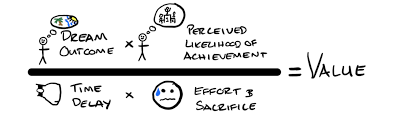
Alex Hormozi's Value Equation from $100M Offers. The higher your score, the easier your offer is to sell.
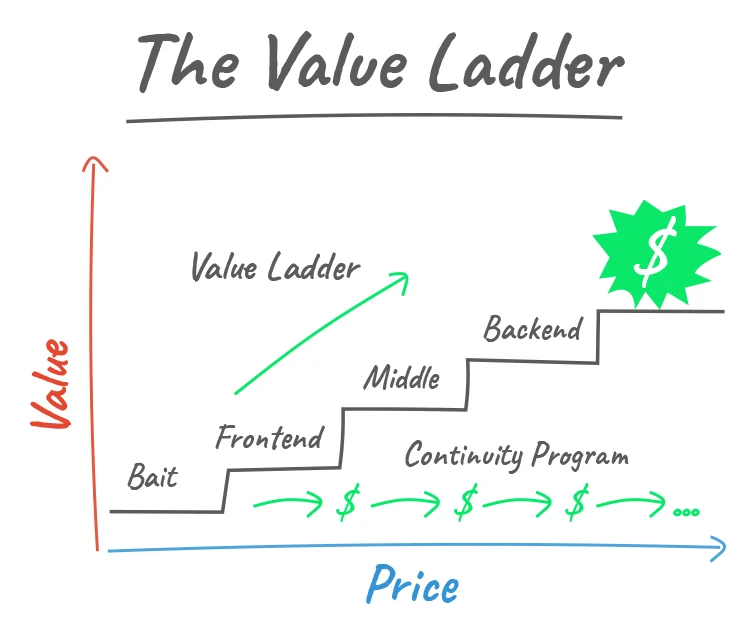
Understanding the Value Ladder
The Value Ladder structures your offers in ascending levels of value and price. Start with something irresistible and low-barrier, then build trust and deliver more value at each step up.
Why it works
The stages
Free value that builds trust and captures leads.
Low-ticket product that converts leads into buyers.
Your main product delivering the full solution.
Ongoing value through memberships or add-ons.
Premium, high-ticket solution for your best customers.
Framework: Russell Brunson — DotCom Secrets