Hush - Postpartum Support Companion
Private postpartum support, any hour
Hush is an AI-powered postpartum companion that gives new mothers private, judgment-free emotional support at any hour, including night feeds. It pairs mood and EPDS-style check-ins with a shared support plan that turns vague overwhelm into specific, assigned requests for partners and family. It escalates to hotlines and licensed providers when needed.
- First revenue
- 90-150 days
- Capital
- $25K-$75K
- Difficulty
- High
- Year one
- $35K-$60K
- Ceiling
- $3M-7M ARR
Researched 19 Nov 2026
Mothers don't just need comfort. They need help.
- Who it's for
- new mothers in their first 12 months postpartum, especially those whose partner or family support is thin or unreliable
- What it does
- a private, anonymous AI postpartum companion that checks in on mood with EPDS-style screening and turns vague overwhelm into a shared support plan (person, task, time, backup), with clear escalation to hotlines and licensed providers
- What changes
- Instead of silently struggling through night feeds and waiting six weeks for a checkup, a mother gets private support in minutes and a plan that gets her partner doing specific tasks.
- Biggest risk
- Crowded field of postpartum AI companions: Bloomest, MumWell, Peri, Cuddle and MamaLift Plus already combine AI, screening and escalation, and Maven Clinic holds the employer channel.
Insurers are buying postpartum mental health
WPS, a health insurer, acquired women's mental health platform Mavida Health on Jun 16 2026, and Maryland enacted perinatal behavioral health coverage in May 2026, so postpartum mental health is now being bought and funded by payers.
Health insurer WPS Health Solutions acquired Mavida Health, a digital mental health platform providing therapy and psychiatry for women, including postpartum depression and anxiety. Mavida will operate independently and plans to expand into new states.
Behavioral Health BusinessGovernor Wes Moore signed HB 1118, the Health, Health Insurance, and Health Occupations: Perinatal behavioral health coverage bill, into law in Maryland.
AP News (EIN Presswire)Aeroflow Health, a technology-enabled healthcare company, acquired Canopie, Inc., a digital health company providing evidence-based preventive support for new mothers, to extend its maternal health platform.
GlobeNewswireCarea launched Carea Connect, which it describes as the first pregnancy and postpartum app to use women's wellbeing data to identify when specialist support may help and prompt connection with experts. The release states mental health remains a leading cause of maternal deaths up to a year after childbirth.
CareaWHO/Europe and Ireland's Department of Health and HSE launched a roadmap on using online therapy, apps and AI safely in mental health care, warning that making digital the default route into care risks deepening inequalities.
WHO/EuropeSenators Tammy Baldwin and Jeanne Shaheen, with Representative Gwen Moore, introduced the MAMA Act to require private and public health plans covering mental health and addiction care for pregnant and postpartum women to provide that care without a copay.
U.S. Senator Tammy BaldwinThe loneliness, in mothers' own words
6 quotes“Lack of the instrumental support to help with these basic needs was seen as the cause for depressive symptoms.”
“I guess I felt depressed more so with this one ‘cause I didn’t have the help from the father as much as I expected I was going to get.”
“The report reveals six out of ten new parents say they feel lonely or isolated at least some of the time (62%), with more than one in ten (12%) saying they always felt lonely after having a baby.”
Everyone built a chatbot. No one built the help request.
4 competitors mapped| Product | From | What it does | The gap |
|---|---|---|---|
|
|
CA$2,400 per family per y... | A private postpartum companion app where mothers can talk to an AI ... | — |
|
|
Free (limited access); 14... | A therapeutic care app for mothers offering gentle mental health su... | — |
|
|
As low as $29 per visit; ... | Virtual women's and family health platform offering clinical, emoti... | — |
|
|
A national nonprofit providing free peer-led support for postpartum... | HelpLine does not handle emergencies |
Watch it. The wedge is practical help, not another companion.
watch medium confidenceThe pain and the payer momentum are real, but at least eight postpartum AI companions already exist, so only build Hush if you commit to the practical-support-plan wedge rather than another mood chatbot.
✓Why it works
- +The top-ranked pain, unmet basic needs driving depressive symptoms, is not addressed by the profiled apps, which focus on mood, screening and conversation
- +Isolation is widespread: 79% of postpartum parents report feeling isolated (RAPID) and 62% feel lonely at least some of the time (NCT)
- +Payers are moving: WPS acquired Mavida Health (Jun 2026), Maryland enacted perinatal behavioral health coverage (May 2026), and the MAMA Act was introduced (Jan 2026), which opens a B2B2C path
- +Dowa's free tier and 14-day trial show a freemium model works, and a $9.99/mo core price sits below Dowa's $13/mo
!What could kill it
- −Direct AI-companion rivals already exist (Bloomest, MumWell, Peri, Cuddle, MamaLift Plus), and Maven Clinic owns the employer channel
- −Search demand is tiny (postpartum support volume 5, postpartum therapy 3), so organic search will not drive acquisition
- −AI safety and privacy on sensitive mental health topics are a real liability, and WHO/Europe warned in Nov 2026 that digital-first care must be built safely
- −The postpartum window is only 12 months, so churn is structurally high and the business needs continual new-mother acquisition
Risks & mitigations
Crowded field of postpartum AI companions: Bloomest, MumWell, Peri, Cuddle and MamaLift Plus already combine AI, screening and escalation, and Maven Clinic holds the employer channel.
HighMitigation: Do not compete as a mood chatbot. Lead with the support-plan wedge that none of the profiled apps show, and target mothers with unreliable partner or family support.
AI safety and liability on sensitive mental health topics. WHO/Europe warned in Nov 2026 that digital-first care must be built safely, and a bad crisis response could harm a user and the brand.
HighMitigation: Use a crisis classifier with fixed escalation to the National Maternal Mental Health Hotline and 988, red-team before launch, and have a perinatal clinician review the prompts and screening copy.
Regulatory drift: positioning as wellness avoids FDA clearance only while Hush does not claim to diagnose or treat. Screening features and the HIPAA, GDPR and state health-data rules can pull it into regulated territory.
MediumMitigation: Keep screening framed as an aid, avoid treatment claims, minimize data collection, and get a healthcare-privacy legal review before launch and before any payer or employer deal.
Low search demand (postpartum support volume 5, postpartum therapy 3) and a 12-month user lifespan make paid and organic acquisition expensive and churn high.
MediumMitigation: Acquire through doulas, childbirth educators, lactation consultants and mom-creator content, and add partner seats and a referral loop. Pursue B2B2C pilots where acquisition is bundled.
Payer consolidation: WPS acquired Mavida Health and Aeroflow acquired Canopie in Jun 2026, so well-funded players with distribution may bundle similar support for free.
MediumMitigation: Stay consumer-first and anonymous, which payer-owned products cannot easily match, and position as a partner or acquisition target for clinics and plans.
400 subscribers and two pilots make $7K a month
EstimatesGo-to-market
- Launch strategy
- Search volume is tiny (postpartum support 5, postpartum therapy 3), so SEO and paid search are not the wedge. Launch through trust channels: a free anonymous check-in, mom-creator content on the 'help you expected never shows up' experience, and partnerships with doulas and clinics. Use the 2026 news hooks (Maryland's HB 1118 perinatal coverage, the MAMA Act, WPS buying Mavida Health) in outreach to payers and clinics. Wedge against Maven Clinic and Bloomest by being private, consumer-first, and focused on practical help rather than visits or conversation.
- First 100 users
- Recruit 30-40 doulas and childbirth educators who each refer 2-3 clients, run a handful of partnered sessions with local new-parent groups, offer 20 mothers a founding free year in exchange for feedback, and have 5-10 mom creators share the check-in. Invite partners through the support-plan link, which doubles as a referral loop.
- Pricing validation
- Run the free check-in and a $19 Support Plan Kit pre-sale before building the subscription. Then A/B test $7.99, $9.99 and $12.99 per month against Dowa's $13/mo anchor, and run two paid pilots with clinics or employers to test the $1,500/mo B2B price.
Turn this research into a build plan
The wizard drafts the remaining steps from this idea in seconds.
Run any agent on this idea
 Founder Archetype
Ten quick scenarios reveal which of six builder types you are — Maker, Hustler, Closer, Storyteller, Connector or Visionary — plus your wing, your blind spot, and who to build with.
~10 min
 Check Founder Fit
Is this idea actually right for you? A fast, honest gut-check.
~5 min
 Funnel Architect
Design the full funnel from traffic source through lead capture to conversion.
20–40 min
 Master Money Model
Pricing, revenue streams, cohorts and simple financial projections.
15–30 min
 Landing Page Architect
Write and build conversion-optimized landing pages for lead capture or sales.
15–30 min
 Lead Magnet Legend
Design lead magnets and hooks that bridge to your main offer.
15–25 min
Year one, on a napkin
$35K-$60K year 1What the first year looks like if the assumptions hold.
The $9.99/mo price is anchored to Dowa's $13/mo and Maven's $29 per visit; reach, conversion, churn and pilot count are guesses with no supporting data, and year-one cash is lower than the ARR run-rate because MRR ramps through the year.
Value Equation Breakdown
Alex Hormozi's framework for understanding if an idea will be easy to sell. Higher scores = easier sell.
5.5/10
↑Maximize these
A new mother feels heard and less alone at any hour, gets concrete help from the people around her, and knows early when she needs a professional. Hush is wellness support, not a treatment for postpartum depression.
Moderate. The pains are well documented (79% feel isolated, instrumental support tied to depressive symptoms), but there is no direct willingness-to-pay data, and at least eight postpartum-specific AI and app competitors already exist, so trust must be earned.
↓Minimize these
Immediate comfort from the first chat. The support plan pays off within days, once partners accept the requests. Mood trends take 2-4 weeks to become useful.
Low effort for an exhausted mother: short check-ins and a few taps. The real cost is trust, since she must share sensitive feelings with an AI, and getting a partner to engage with the plan.

Alex Hormozi's Value Equation from $100M Offers. The higher your score, the easier your offer is to sell.
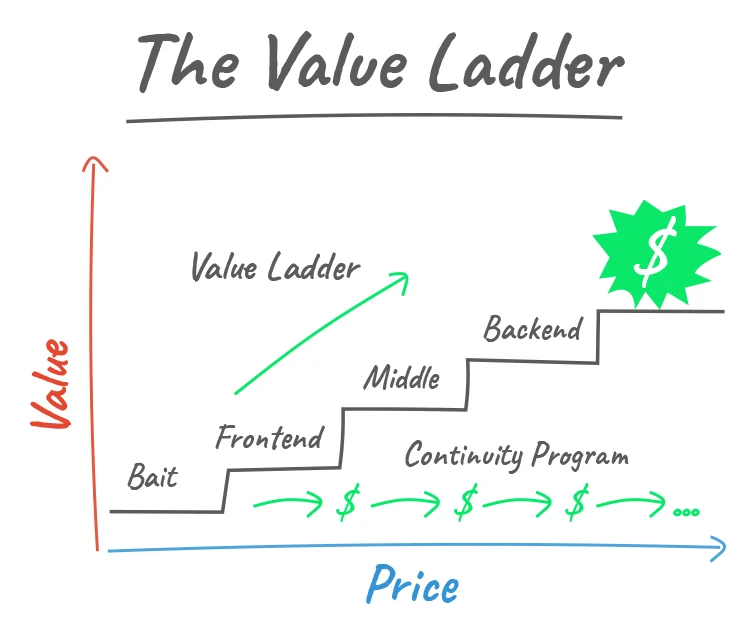
Understanding the Value Ladder
The Value Ladder structures your offers in ascending levels of value and price. Start with something irresistible and low-barrier, then build trust and deliver more value at each step up.
Why it works
The stages
Free value that builds trust and captures leads.
Low-ticket product that converts leads into buyers.
Your main product delivering the full solution.
Ongoing value through memberships or add-ons.
Premium, high-ticket solution for your best customers.
Framework: Russell Brunson — DotCom Secrets