ClassClose - Burnout Recovery for Teachers
Leave school at school
A private, teacher-specific burnout app that helps exhausted educators shut down the workday, track mood and stress early, and recover with 2-5 minute guided routines. When symptoms go beyond self-help, it hands off to licensed therapists at transparent prices.
- First revenue
- 45-90 days
- Capital
- $10K-$30K
- Difficulty
- Moderate
- Year one
- $30K-$60K
- Ceiling
- $3M-8M ARR
Researched 10 Nov 2026
Teachers aren't failing at self-care. The job never ends
- Who it's for
- K-12 teachers, especially first-year and early-career educators, who are exhausted by after-hours work and classroom stress
- What it does
- a private, teacher-owned burnout app that gives 2-5 minute end-of-day shutdown rituals, mood and workload check-ins and boundary nudges, with a transparent handoff to licensed therapists when needed
- What changes
- Evenings spent grading and staring at nothing become a 3-minute shutdown ritual and a real off switch.
- Biggest risk
- Alongside for Educators offers AI-assisted K-12 wellness coaching for free, and districts are rolling out free tools like Starling Minds (19,000 Ohio staff), which caps what teachers will pay.
Districts and governments are finally paying for teacher burnout
Since Jan 2026, governments, districts and investors have moved on teacher burnout, from a Brazilian bill (Jul 2026) to Ohio's 19,000-staff app rollout (Jul 1, 2026) and Daybreak's K-12 investment (Oct 28, 2026).
Brazil's Projeto de Lei 1206/26, now in the Chamber of Deputies, would require public and private schools and universities to offer psychological support to all school-community professionals, from teachers to cleaning and security staff.
CONTEEAustralian employers have been legally required since April 2023 to manage psychosocial hazards such as unrealistic workloads. A Nov 2026 article calls burnout a rising legal risk for schools.
The Educator K/12Aon's 2026 Independent Schools Risk Report (306 Australian schools surveyed Jan–Mar 2026) ranks mental health the third-highest risk, with a workers' compensation cost attached. Talent attraction and retention ranked second.
The Educator K/12The Southwestern Ohio Educational Purchasing Council (19,000 staff across 110 districts) launched the Starling Minds mental fitness benefit, a free, confidential, 24/7 self-guided program, from July 1, 2026.
Starling MindsFullBloom invested in Daybreak Health to pair virtual therapy with its CharacterStrong division for K-12 schools, a sign of consolidation and capital flowing into school mental health.
The Manila Times (GlobeNewswire)Teacher's Buddy, an AI platform for educators, raised NZD $2.3M in seed funding led by Soul Capital, with 12,000+ teachers in 130 countries adopting it within 18 months of launch.
CFOtech NZBurnout, in teachers' own words
6 quotes“I've always been told not to take work home with you, but I cannot find time to do it at work because it seems like the building closes down earlier and earlier to the point where I have to bring grades, lesson plans,...”
“I’m beyond tired, I don’t have the energy to do anything, and that unfortunately includes looking for jobs, or going back to school for a career change.”
Therapy and school programs are crowded. The private after-hours boundary is open
6 competitors mapped| Product | From | What it does | The gap |
|---|---|---|---|
|
|
Free; free access for all... | AI-assisted wellness coaching for K-12 staff covering burnout preve... | — |
|
|
$70-$100/week (US); from ... | The world's largest 100% online therapy platform. It matches users ... | Reputation concerns: prospective users ask if it is a 'sc... |
|
|
Meditation and sleep app with sleep stories and breathing exercises... | Generic relaxation content, not teacher-specific; one com... | |
|
|
Popular meditation and mindfulness app frequently recommended to te... | Generic wellness content, not teacher-specific or built f... | |
|
|
From $69/week out-of-pock... | An online therapy platform offering therapy for teachers, school st... | — |
|
|
About £950/year for a ~50... | UK-built wellbeing app giving school staff private, preventative we... | — |
Watch it. Prove teachers will pay before you build
watch medium confidenceThe pain is real and the after-hours-boundary wedge is open, but free, school-funded and teacher-specific rivals crowd the category and consumer retention is weak, so validate demand with a waitlist before building.
✓Why it works
- +Teachers voice the pain loudly and often, e.g. 'I’m beyond tired, I don’t have the energy to do anything', and the work-spillover pain ranked #1 in the research.
- +No competitor in the research owns the after-hours boundary and low-energy recovery position; teacher-specific rivals skew to therapy (Teacher Talk) or school-sold programs (Teacher Restore, OpenUp, ifeel).
- +Why-now momentum: Ohio's 19,000-staff Starling Minds rollout, Daegu's renewed Maum Suup contract, and Teacher's Buddy's NZD $2.3M seed show budgets and investors moving in.
- +A modest MVP can be built in 8-10 weeks, and a $79/yr plan sits far below BetterHelp's $70-$100/week.
!What could kill it
- −Alongside for Educators gives K-12 staff AI wellness coaching for free, which caps what teachers will pay for a similar tool.
- −BetterHelp and Talkspace already market to teachers with discounts and employer partnerships, and districts are buying free tools like Starling Minds.
- −Search demand is tiny (teacher burnout volume 11, teacher mental health 18), so distribution depends on Reddit and outbound, and consumer churn of 40-50% a year is likely.
- −Selling to schools takes 6-12 months per deal, and any clinical claims bring regulatory and liability exposure.
Risks & mitigations
Alongside for Educators offers AI-assisted K-12 wellness coaching for free, and districts are rolling out free tools like Starling Minds (19,000 Ohio staff), which caps what teachers will pay.
HighMitigation: Don't compete on generic coaching. Own the after-hours boundary and low-energy recovery niche with a private, employer-blind design, and use the free tier for lead generation while charging for tracking, programs and handoff.
BetterHelp and Talkspace already market to teachers with discounts (BetterHelp's 50% off for two months, Talkspace's school-staff offering) and employer partnerships such as Teach For America.
MediumMitigation: Position as the daily layer, not a therapy marketplace. Partner for handoff to therapists with transparent pricing so those platforms act as referral partners rather than rivals.
Consumer retention is likely weak (40-50% annual churn is assumed) because exhausted teachers drop habits, and search demand is tiny (teacher burnout volume 11).
HighMitigation: Design for very low effort (skippable 3-minute flows), offer annual plans, grow through Reddit and content rather than search, and use school and union seat contracts to offset churn.
Clinical and privacy liability: mental health data from teachers, crisis situations and health claims could trigger regulatory or legal exposure.
HighMitigation: Position as non-clinical wellbeing, build a crisis-resource layer, encrypt check-in notes, keep data employer-blind, get legal review on claims and consider partnering with licensed clinicians for the guided program.
School and district sales cycles run 6-12 months, and rivals such as Teacher Restore (about £950/yr per school), OpenUp and ifeel already hold institutional relationships.
MediumMitigation: Lead with direct-to-teacher sales, then use the 2026 hooks (Australia's psychosocial duty since 2023, Brazil's PL 1206/26, Ohio's rollout) with unions and school leaders, starting with small paid pilots.
384 teachers and 12 schools make about $4.8K a month
EstimatesGo-to-market
- Launch strategy
- Search is not the wedge: 'teacher burnout' volume is 11 and 'teacher mental health' 18 on the trends index. Lead with community and outbound. Start with a free burnout self-check and shutdown-ritual template shared in teacher subreddits, run a waitlist and beta with first-year teachers, then launch publicly in the August back-to-school window. Use news hooks, such as districts like Ohio's 19,000-staff program buying free tools, to pitch unions and schools on a private, employer-blind alternative.
- First 100 users
- Post free shutdown-ritual templates and the burnout self-check in r/Teachers, r/teaching and r/TeachersInTransition, replying to burnout threads (e.g. 'What do you do about burnout?'). Interview 30 first-year teachers from those threads and enroll them in a closed beta. Message 20 teacher creators and union wellbeing leads for beta access and shout-outs. Collect waitlist emails with the lead magnet and convert them with a founder-led onboarding email.
- Pricing validation
- Run the waitlist with a 'what would you pay' question ($0, $5, $9, $15/month) and test a $19 30-Day Boundary Reset as a pre-sale. Measure how many beta users convert from the 7-day trial to $79/yr and compare against BetterHelp ($70-$100/week) and Teacher Restore (~£19 per teacher/yr) as price anchors. Test the school seat price ($30/seat) with five paid pilots before building admin features.
Turn this research into a build plan
The wizard drafts the remaining steps from this idea in seconds.
Run any agent on this idea
 Founder Archetype
Ten quick scenarios reveal which of six builder types you are — Maker, Hustler, Closer, Storyteller, Connector or Visionary — plus your wing, your blind spot, and who to build with.
~10 min
 Check Founder Fit
Is this idea actually right for you? A fast, honest gut-check.
~5 min
 Funnel Architect
Design the full funnel from traffic source through lead capture to conversion.
20–40 min
 Master Money Model
Pricing, revenue streams, cohorts and simple financial projections.
15–30 min
 Landing Page Architect
Write and build conversion-optimized landing pages for lead capture or sales.
15–30 min
 Lead Magnet Legend
Design lead magnets and hooks that bridge to your main offer.
15–25 min
Year one, on a napkin
$30K-$60K year 1What the first year looks like if the assumptions hold.
Prices are anchored to real competitors (Teacher Restore ~£19 per teacher/yr, BetterHelp $70-$100/week). Traffic, conversion, pilot count and seats per pilot are guesses, and cash collected in year one will be below the ARR run-rate.
Value Equation Breakdown
Alex Hormozi's framework for understanding if an idea will be easy to sell. Higher scores = easier sell.
6.2/10
↑Maximize these
Finish the school day without carrying it home, feel rested enough to enjoy evenings and weekends, and decide whether to stay in teaching from a place of recovery rather than exhaustion. It does not fix structural workload or student-behavior drivers.
Moderate. Pain is loudly and repeatedly voiced on Reddit, and 2026 signals (Ohio's 19,000-staff app rollout, a Canadian text-messaging study) support digital interventions. But NEA-cited educators warn that individual self-care can't fix a systemic problem, and apps like Alongside are free.
↓Minimize these
Shutdown rituals and check-ins help within the first week. Real recovery and habit change take weeks to months.
Low by design: 2-5 minutes a day, no scheduling, no employer involvement. Teachers pay a modest subscription and must build a new habit when they are already drained.
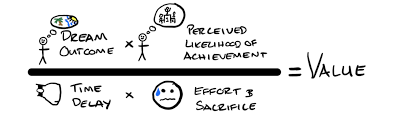
Alex Hormozi's Value Equation from $100M Offers. The higher your score, the easier your offer is to sell.
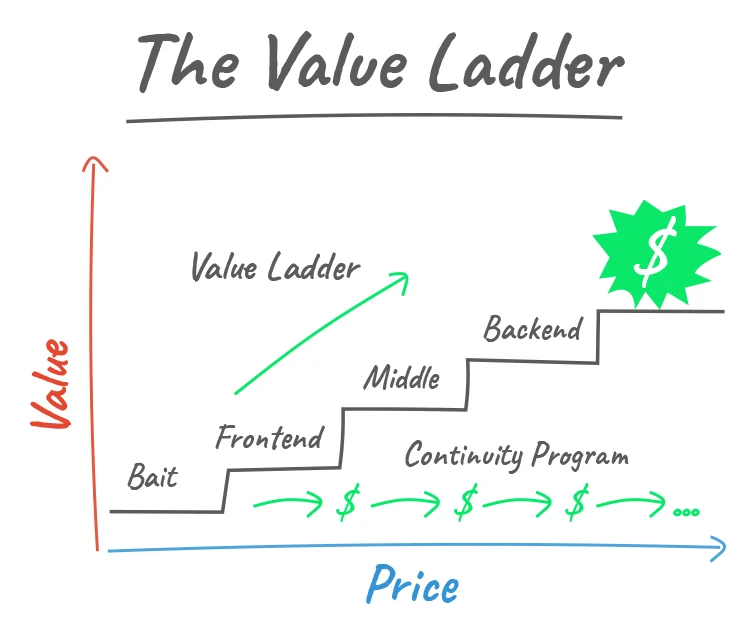
Understanding the Value Ladder
The Value Ladder structures your offers in ascending levels of value and price. Start with something irresistible and low-barrier, then build trust and deliver more value at each step up.
Why it works
The stages
Free value that builds trust and captures leads.
Low-ticket product that converts leads into buyers.
Your main product delivering the full solution.
Ongoing value through memberships or add-ons.
Premium, high-ticket solution for your best customers.
Framework: Russell Brunson — DotCom Secrets