PlayScribe - Text-to-Game Builder for Non-Coders
Describe your game. Play it today.
PlayScribe turns a plain-text game idea into a playable, story-first browser game. Rules are written as sentences and kept readable, with media built in and clean export. It is for imaginative people who can't code and don't want to wire up blocks, events or markup.
- First revenue
- 60-120 days
- Capital
- $10K-$30K
- Difficulty
- High
- Year one
- $20K-$45K
- Ceiling
- $3M-8M ARR
Researched 22 Nov 2026
The wall isn't ideas. It's the logic step.
- Who it's for
- non-technical writers, hobbyists, teachers and tabletop RPG creators who have game ideas and want a playable result in the browser
- What it does
- a text-to-game builder where rules are written as plain sentences and compiled into readable, editable logic, with built-in media and clean export, so the creator stays in the story instead of the syntax
- What changes
- A game idea that used to need weeks of learning blocks or syntax becomes a playable scene in minutes.
- Biggest risk
- Platform giants are giving away prompt-based game creation: Google Playground (Oct 2026), Roblox Build and its claim that over 80% of top games use AI, and Unity Spark with the Synty acquisition.
Google, Roblox and Unity just made text-to-game mainstream
Google launched Playground on Oct 7 2026 and Roblox said on Nov 13 2026 that creators of over 80% of top games now build with AI, so text-to-game creation went mainstream within weeks.
Google introduced Playground, a platform where users create, play and share custom games by describing them in simple text prompts with no coding required.
Google BlogUnity acquired asset pack maker Synty Studios to supply content for Unity Spark, its AI game creation platform built around no-code prompting.
GamingOnLinuxRoblox launched Build, a mobile-first AI creation tool, stating that someone with a game idea 'just doesn't know how to build it' and that this now changes.
RobloxSequoia-backed Astrocade raised $56 million to let anyone build games with natural-language AI prompts; it launched in August 2025 and its Series B was led by Sequoia.
FortuneVerse8 raised a $5 million seed round for an AI-native platform that generates fully playable multiplayer games from natural language prompts.
GamesBeatThe wall, in their own words
5 quotes“Then you need a condition, and you are writing (if: $trust > 3) inside your prose.”
“Then you need a counter, an inventory, a reputation score, and the passage that was a scene is now half logic.”
Everyone generates arcade games. Few keep the story readable.
8 competitors mapped| Product | From | What it does | The gap |
|---|---|---|---|
| Astrocade | An AI games platform and social feed where creators make, remix and... | — | |
|
|
Free plan (paid tiers not... | A free, open-source no-code game engine with drag-and-drop events a... | Roam's comparison says GDevelop suits people who plan to ... |
|
|
Lets users describe a game in plain English and receive a playable ... | — | |
|
|
A no-code AI game maker that builds a playable browser game from a ... | — | |
|
|
An AI game builder that turns a prompt into a playable browser game... | — | |
|
|
Free to download and play... | A describe-it iPhone app where the user describes a game in a sente... | No project file, and no Android app yet (roam.gg) |
|
|
Free to start; paid plans... | A browser-based AI game builder where users describe a game in a se... | — |
|
|
An AI game maker that builds a real Godot 4-compatible project from... | — |
Watch it. Build only with a narrow story-first wedge.
watch medium confidenceThe pain is real, but Google, Roblox, Unity and venture-backed Astrocade are all moving into prompt-based game creation, so only build if you commit to a narrow story-first wedge with readable, portable logic.
✓Why it works
- +The logic-building barrier is documented: 'If you just want the game, that step is the wall' (roam.gg), and Twine users report scenes turning 'half logic'.
- +Timing is strong: Google Playground (Oct 2026), Roblox Build (Jul 2026) and Unity Spark show non-technical creators are the audience platforms are racing to capture.
- +Competitor research shows an unmet combination: plain-language rules, built-in media and format-neutral export, which no single competitor offers end to end.
- +Story-first and teacher/TTRPG niches are underserved by arcade-focused generators like Rosebud AI and Luddi.
!What could kill it
- −Astrocade raised $56M, and Google, Roblox and Unity are shipping free or bundled prompt-to-game tools. Distribution and model costs favor them.
- −Free incumbents (Twine, GDevelop, ChoiceStory Studio's free tier) cap pricing, and the comparable paid anchors are small ($30 one-time StoryFlow Editor, $6/mo StorySplice).
- −Pain evidence is thin: almost all of it is vendor marketing copy, with no Reddit, Hacker News or review-site user complaints, and Google Trends volumes are near zero.
- −AI iteration costs and unclear ownership of AI-generated assets could squeeze margins and trust.
Risks & mitigations
Platform giants are giving away prompt-based game creation: Google Playground (Oct 2026), Roblox Build and its claim that over 80% of top games use AI, and Unity Spark with the Synty acquisition.
HighMitigation: Don't compete on generic arcade output. Own story-first and classroom games, with readable portable logic and export that closed platforms won't offer.
Venture-funded rivals (Astrocade, $56M Series B; Verse8, $5M seed) and direct tools like Rosebud AI, Teleplay and Manus can outspend on model quality and user acquisition.
HighMitigation: Stay niche (writers, TTRPG creators, teachers), keep burn low, and win on community and template depth rather than raw generation.
Weak willingness to pay: Twine, GDevelop and ChoiceStory Studio are free, and the paid anchors are small (StoryFlow Editor $30 one-time, StorySplice Pro $6/mo). The pain evidence is also mostly vendor copy.
HighMitigation: Pre-sell $9-19/mo plans to 20-30 writers and teachers before building the full product, and validate directly with user interviews.
Regulation and content risk: the EU KIDS Act proposal (COM(2026) 681) names online game providers, and AI-generated content and asset ownership are unclear, which matters for classroom use.
MediumMitigation: Ship moderation and age-gated publishing from day one, state a clear asset licence, and add compliance review before targeting schools in the EU.
Generated games can be shallow or buggy and credit-based iteration costs add up, which competitors' comparisons already point out as a ceiling for non-technical users.
MediumMitigation: Keep generation deterministic through a rules schema, cache generations, undo any AI change, and set credit caps that are visible to users.
144 creators, $3.4K a month, a slow start
EstimatesGo-to-market
- Launch strategy
- Search demand is near zero (Google Trends volumes of 0-39), so SEO and paid search are not the wedge. Lead with community and content. Use the Google Playground and Roblox Build news as a hook ('everyone's making games from text; here's one that keeps your story readable') and run a free scene-generator demo in a game jam.
- First 100 users
- Enter one or two story game jams with a PlayScribe-built entry and publish a 'made in 20 minutes' write-up. Individually invite 50 Twine users and writers from interactive fiction forums and Discords to try the free generator. Offer 10-15 teachers a free classroom pilot, and post short demo clips of paragraph-to-game builds.
- Pricing validation
- Before launch, collect refundable pre-orders or founding-member offers at $9/mo and $19/mo from 20-30 writers and teachers. Test whether they prefer monthly or annual billing against StoryFlow Editor's $30 one-time price.
Turn this research into a build plan
The wizard drafts the remaining steps from this idea in seconds.
Run any agent on this idea
 Founder Archetype
Ten quick scenarios reveal which of six builder types you are — Maker, Hustler, Closer, Storyteller, Connector or Visionary — plus your wing, your blind spot, and who to build with.
~10 min
 Check Founder Fit
Is this idea actually right for you? A fast, honest gut-check.
~5 min
 Funnel Architect
Design the full funnel from traffic source through lead capture to conversion.
20–40 min
 Master Money Model
Pricing, revenue streams, cohorts and simple financial projections.
15–30 min
 Landing Page Architect
Write and build conversion-optimized landing pages for lead capture or sales.
15–30 min
 Lead Magnet Legend
Design lead magnets and hooks that bridge to your main offer.
15–25 min
Year one, on a napkin
$20K-$45K year 1What the first year looks like if the assumptions hold.
Traffic, conversion and retention are guesses; prices are anchored to StoryFlow Editor ($30 one-time) and StorySplice Pro ($6/mo), and market figures rest on an assumed $2,000/yr per developer.
Value Equation Breakdown
Alex Hormozi's framework for understanding if an idea will be easy to sell. Higher scores = easier sell.
5.5/10
↑Maximize these
Write a paragraph about your game and get a playable, shareable browser game whose rules you can still read and change. It will be strongest for story-first and simple games, not complex 3D titles.
Medium. Many prompt-to-game tools (Rosebud AI, Teleplay, Manus, Replit) show the category works. The research also shows generated output can be shallow, and no direct user quotes confirm that buyers will pay.
↓Minimize these
Minutes to a first playable scene; hours to polish a short branching game.
Low effort to start, but users must refine prompts and accept less control than an engine gives. Moving from Twine means rebuilding scripts, since custom macros do not map cleanly between formats.
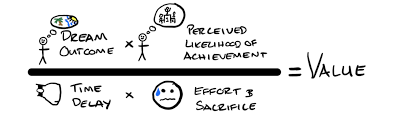
Alex Hormozi's Value Equation from $100M Offers. The higher your score, the easier your offer is to sell.
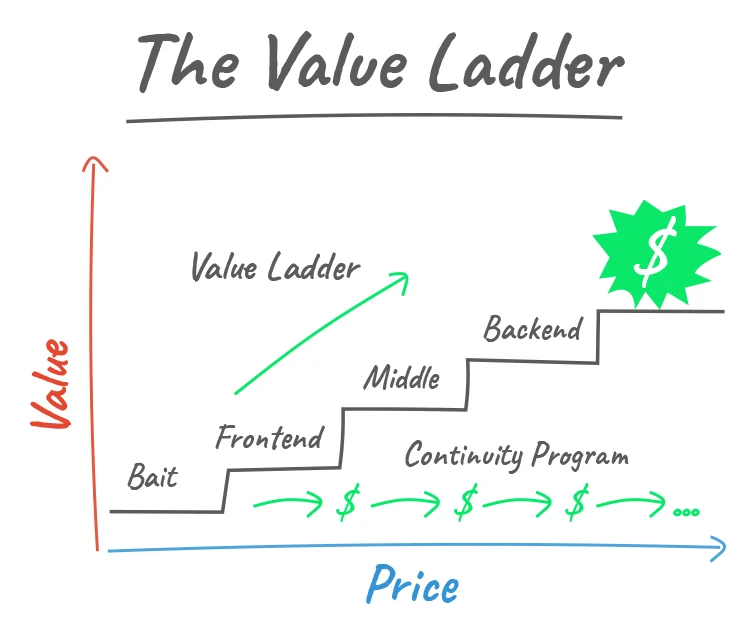
Understanding the Value Ladder
The Value Ladder structures your offers in ascending levels of value and price. Start with something irresistible and low-barrier, then build trust and deliver more value at each step up.
Why it works
The stages
Free value that builds trust and captures leads.
Low-ticket product that converts leads into buyers.
Your main product delivering the full solution.
Ongoing value through memberships or add-ons.
Premium, high-ticket solution for your best customers.
Framework: Russell Brunson — DotCom Secrets